

If you want to scale your business online, you first need to understand what is SEO. Search Engine Optimization or SEO is the practice of improving your website so it appears higher in search engine results when someone searches for a topic, product or service related to your business.
When someone types “best digital marketing consultant” or “affordable SEO services for small business” into Google, the results they see are not random. They are determined by a complex algorithm that evaluates hundreds of signals to decide which pages best answer the query. SEO is the work you do to make sure your page is one of those answers.
As Neil Patel puts it: “SEO is not about gaming Google. It is about partnering with Google to provide the best search results for users.”
That definition is worth sitting with. The businesses that treat SEO as a shortcut or a trick consistently underperform. The businesses that treat it as a long-term investment in genuine relevance and authority consistently win. They understand that the foundational google ranking factors aren’t a checklist to game the system, but a roadmap for delivering the best possible user experience.
I have been delivering SEO services to clients across the United States, United Kingdom, Canada, Australia, Germany, Netherlands, Ireland, New Zealand, Singapore, United Arab Emirates since 2022. In every engagement, the pattern is the same. Businesses that invest in properly executed SEO generate compounding organic traffic that continues to grow long after the initial investment. Businesses that rely solely on paid advertising start over every time they pause their budget.
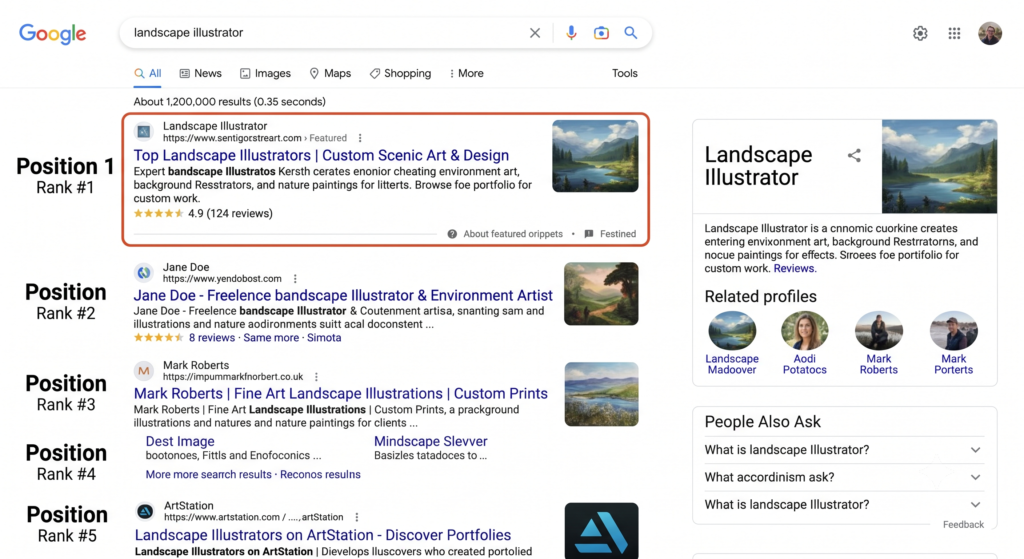
Example of a search engine results page showing SEO ranking positions
Why SEO Matters More Than Ever in 2026
Before I explain how SEO works or break down the core concepts of seo for beginners, it is worth understanding why it matters now more than it ever has.
According to BrightEdge research, organic search drives 53% of all website traffic across industries. That is more than paid advertising, social media, email, and direct traffic combined. If your website is invisible in search results, you are invisible to more than half the people who could be finding you.
But here is what makes 2026 different from five years ago. SEO is no longer just about ranking in Google. AI search is reshaping how people find information.
Google AI Overviews now appear in more than 30% of all searches. ChatGPT processes 800 million queries every week. Perplexity handles 780 million monthly queries. When someone asks one of these platforms a question, they get a direct answer (not a list of ten blue links to click through).
The businesses appearing in those AI-generated answers are not there by accident. They are there because their SEO foundation is strong enough that AI systems trust and cite their content. This means organic SEO and AI search optimization are no longer separate disciplines. They are one connected strategy.
Rand Fishkin of SparkToro describes this shift clearly that “The goal of modern SEO is no longer just to rank on a results page. It is to become the source those results pages and AI answers cite.”
That is the standard I apply to every seo marketing services engagement I deliver. Rankings are a measurement. Authority is the actual goal.
How Search Engines Actually Work
To understand SEO, you need to understand what search engines are actually doing. The process has three stages.
Crawling
Search engines use automated programs called crawlers (or spiders) to discover web pages. These crawlers follow links from page to page, building a map of the web. If your pages are not crawlable (because of broken links, blocked crawl paths or poor site structure) search engines cannot find or evaluate them regardless of how good your content is.
Indexing
Once a crawler finds a page, it processes the content and stores it in a massive database called the index. Only indexed pages can appear in search results. Pages with duplicate content, thin content, or technical errors are often excluded from the index entirely.
Ranking
When someone performs a search, the search engine queries its index and applies a ranking algorithm to determine which pages are most relevant and authoritative for that specific query. Google uses over 200 ranking factors in this process, though the most important ones consistently come down to three things: relevance, authority, and user experience.
Understanding this three-stage process is why technical seo services are not optional. If a search engine cannot crawl or index your site, everything else you do is invisible.
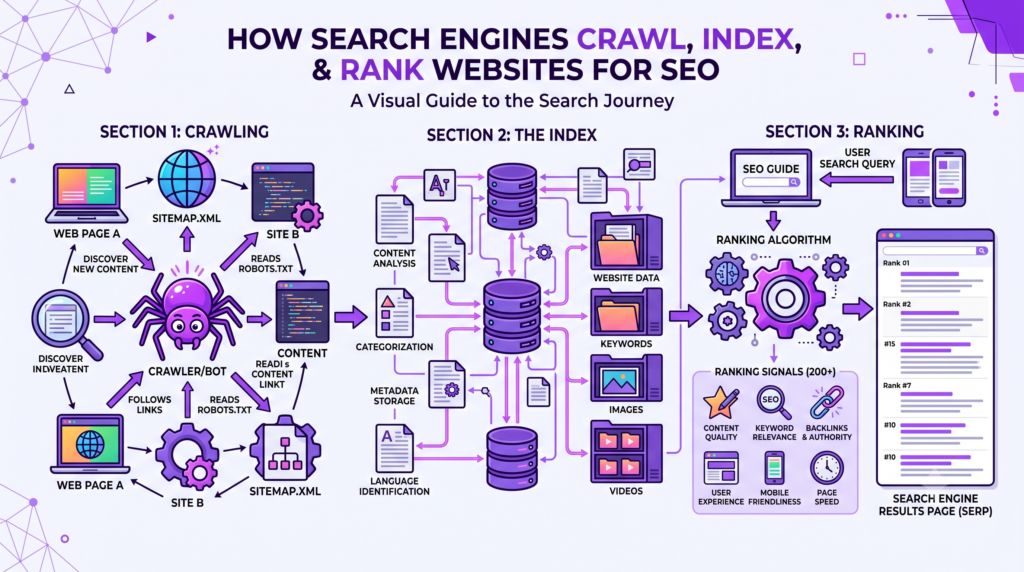
Diagram showing how search engines crawl, index, and rank websites for SEO
The Three Core Types of SEO
SEO is not one thing. It is a collection of disciplines that work together. There are three core types and all three must be working for SEO to deliver results.
On-Page SEO
On-page SEO covers everything on your actual website pages (content, headings, meta data, images, internal links, and keyword usage). It is the most visible layer of SEO and the one most people are familiar with.
Off-Page SEO
Off-page SEO covers everything that happens outside your website – primarily backlinks (other websites linking to yours), brand mentions and authority signals that tell search engines your content is trusted by others in your industry.
Technical SEO
Technical SEO covers the infrastructure of your website (site speed, mobile responsiveness, crawlability, indexation, structured data and Core Web Vitals). It is invisible to readers but highly visible to search engines and is the foundation everything else is built on.
Brian Dean of Backlinko describes the relationship between these three clearly: “Technical SEO gets you in the game. On-page SEO helps you win individual queries. Off-page SEO determines how high you can ultimately rank.”
On-Page SEO: Optimizing What Is on Your Site
On page seo services cover the elements of your website that you can directly control and optimize. Here is what matters most.
Keyword Research and Mapping
Every page on your website should target a specific keyword or keyword cluster. Keyword research identifies the exact phrases your potential customers are using when searching for what you offer, and keyword mapping ensures each keyword has one clear, optimized destination on your site. When multiple pages target the same keyword without a clear hierarchy, you create keyword cannibalization (a situation where your own pages compete against each other and suppress all of them).
Title Tags and Meta Descriptions
Your title tag is the headline that appears in search results. It is one of the strongest on-page ranking signals and should include your primary keyword naturally within the first 60 characters. Your meta description does not directly impact rankings but has a significant effect on click-through rate. A well-written meta description with a clear benefit and a call to action consistently outperforms a generic one.
Heading Structure
Your H1 should appear once and contain your primary keyword. H2 headings should cover the major subtopics on the page. H3 headings break down individual sections within each H2. This hierarchy helps search engines understand the structure . depth of your content and helps readers navigate long posts quickly.
Content Depth and Topical Authority
In 2026, thin content does not rank. Pages that cover a topic comprehensively (addressing the primary query and all the naturally related questions a searcher would have) consistently outperform pages that answer only the surface-level question. Google measures this through a concept called topical authority. The more thoroughly your site covers a topic cluster, the more Google trusts it as a reliable source on that subject.
Internal Linking
Internal links connect related pages within your site, distributing authority from strong pages to weaker ones and helping search engines understand your content architecture. Every blog post should link to at least 3 to 5 related service pages or other blog posts.
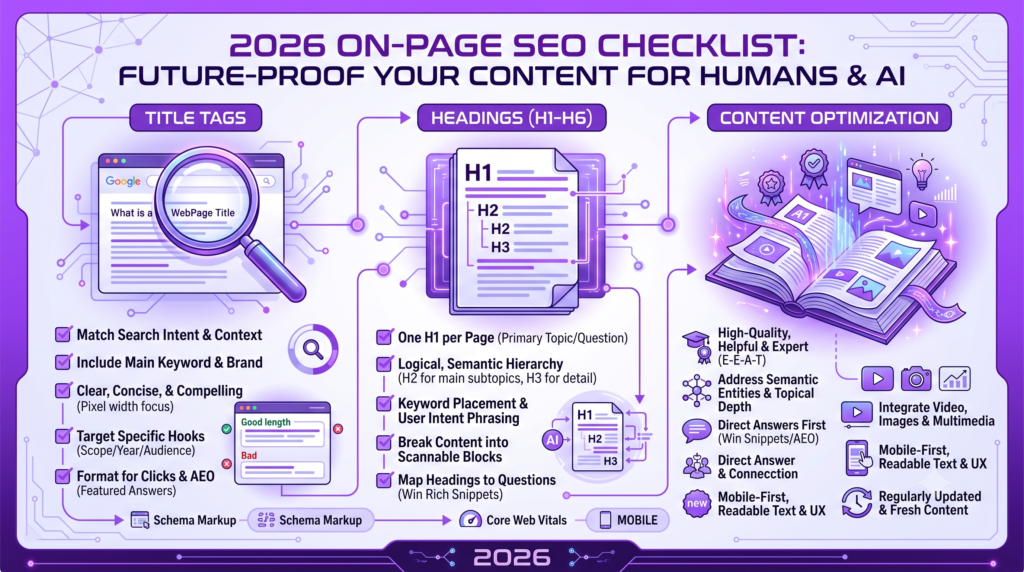
On-page SEO checklist showing key optimization elements including title tags, headings, and content
Off-Page SEO: Building Authority Outside Your Site
Off page seo services focus on signals that exist outside your website but directly influence how much authority Google assigns to your pages.
Backlinks
A backlink is a link from another website pointing to yours. Google treats backlinks as votes of confidence. The more high-quality and relevant websites linking to your content, the more authoritative your pages appear to search engines. Not all backlinks are equal. One link from a respected industry publication is worth more than a hundred links from low-quality directories.
Brand Mentions and Citations
Even without a direct link, mentions of your brand name across the web in news articles, podcasts, social media and industry forums send authority signals to Google. This is particularly important for building a Google Knowledge Panel, as consistent brand mentions across authoritative sources help Google establish you as a recognized entity.
Digital PR and Link Earning
The most sustainable approach to seo link building services is creating content that other websites genuinely want to reference (original research, comprehensive guides, unique data or expert opinions) that add something to the conversation rather than repeating what already exists. As Ahrefs research consistently shows, the pages with the most referring domains rank significantly higher than equally well-optimized pages with fewer external links.
Technical SEO: The Foundation Everything Else Sits On
Technical seo services address the backend infrastructure of your website. Without a solid technical foundation, even the best on-page and off-page SEO efforts are limited.
Site Speed and Core Web Vitals
Google officially uses Core Web Vitals as a ranking signal. These three metrics – Largest Contentful Paint (LCP), Interaction to Next Paint (INP) and Cumulative Layout Shift (CLS) measure how fast your page loads, how responsive it is to user interactions, and how visually stable it is during loading. Pages that fail Core Web Vitals thresholds consistently underperform compared to faster, more stable competitors.
In 2026, INP replaced First Input Delay (FID) as the responsiveness metric within Core Web Vitals. If you have not audited your site against the new INP benchmark, this is a technical priority.
Mobile-First Indexing
Google now indexes the mobile version of your site first. This means your mobile experience directly determines your search rankings, not your desktop experience. If your site is slow, hard to navigate, or visually broken on mobile, your rankings will reflect that regardless of how good the desktop version looks.
Crawlability and Indexation
Search engines need to be able to crawl every important page on your site without hitting blocked paths, broken links, or redirect chains. A proper seo audit service will identify crawlability issues before they compound into ranking problems.
Structured Data and Schema Markup
Schema markup is code you add to your pages to help search engines understand the content more precisely. It enables rich results (star ratings, FAQs, breadcrumbs and event listings) in search results pages. For AI search specifically, schema markup is one of the most important signals for getting your content cited in AI-generated answers.
How AI Search Is Changing SEO in 2026
This is the section most SEO guides written before 2024 are missing entirely. And it is arguably the most important shift happening in search right now.
AI SEO services (optimizing for AI-generated answers alongside traditional rankings) have become a distinct discipline in 2026. Here is why it matters.
When someone asks Google AI Overviews “what are the best SEO services for small businesses” they do not see ten blue links. They see a synthesized answer that names specific recommendations and cites its sources. The businesses named in that answer are not necessarily the ones ranking #1 in organic results. They are the ones whose content is structured in a way that AI systems can extract, verify, and cite with confidence.
According to Whitehat SEO research, traditional SEO metrics predict only 4 to 7% of AI citation behavior. This means the SEO work that gets you onto page one of Google does not automatically get you cited in AI answers. You need additional optimization (structured content, entity signals, FAQPage schema, direct-answer passages) to earn AI visibility.
I cover this in depth in my guide to Answer Engine Optimization (AEO). The short version is this: In 2026, the businesses winning in search are those optimizing for both traditional rankings and AI citations simultaneously. The two strategies reinforce each other; strong SEO makes AI citations more likely, and AI citations drive branded search volume that further boosts organic rankings.
How Long Does SEO Take to Show Results
This is the question I hear most often before a new client engagement begins. The honest answer has two parts.
For technical and on-page improvements, you can see measurable changes in crawl health, indexation, and click-through rates within 4 to 8 weeks. Search engines re-crawl pages regularly, and well-executed technical fixes often produce visible improvements relatively quickly.
For keyword rankings and organic traffic growth, most websites begin to see movement within 3 to 6 months. Significant, compounding organic traffic growth typically becomes visible at 6 to 12 months. In highly competitive niches, the timeline extends further.
The variables that most affect timeline are:
Domain Age and Existing Authority
A website that has been online for five years with an established backlink profile will see results faster than a brand new domain starting from zero.
Competition Level
Ranking for “seo services” (search volume 60,500, KD 38) requires a different investment than ranking for “b2b seo services” (search volume 3,600, KD 16). Lower competition keywords typically move faster.
Content Depth and Publishing Frequency
Sites that consistently publish high-quality, topically authoritative content build ranking momentum faster than sites that publish sporadically. The topical map approach — publishing pillar content and surrounding cluster posts — is the most efficient strategy for building organic authority quickly.
Technical Foundation Quality
Sites with clean technical foundations rank faster. Sites with crawl errors, duplicate content, or slow load times spend the first few months of an SEO engagement just getting out of their own way before rankings can start moving.
What Good SEO Services Actually Include
Not all organic seo services are the same. Here is what a properly structured SEO engagement should include regardless of who you hire.
Technical SEO Audit and Fixes
The starting point of any serious SEO engagement is a full technical audit covering crawlability, indexation, site speed, Core Web Vitals, structured data, duplicate content, redirect health, and mobile performance. Without this baseline, you are building on an unstable foundation.
Keyword Research and Topical Mapping
A good seo content writing services strategy starts with understanding what your target audience is searching for, mapping those keywords to specific pages, and identifying the content gaps your site needs to fill to establish topical authority in your niche.
On-Page Optimization
Every key page on your site should be optimized for its target keyword with proper title tag, meta description, heading structure, content depth, image optimization, and internal linking. This is not a one-time task, it requires ongoing refinement as search behavior evolves.
Content Creation and Publishing
Regular publication of high-quality, topically relevant content is one of the most reliable ways to build organic authority over time. The content strategy should follow a pillar-and-cluster architecture where broad pillar content establishes topical authority and specific cluster posts capture long-tail search traffic.
Link Building and Authority Development
A sustainable seo link building services approach focuses on earning links through genuinely valuable content (original research, comprehensive guides, expert opinions) rather than manipulative tactics that risk Google penalties.
Monthly Reporting
Every SEO engagement should produce monthly reports covering keyword ranking movement, organic traffic changes, technical health status, and the next action priorities. Rankings without revenue context are just numbers.
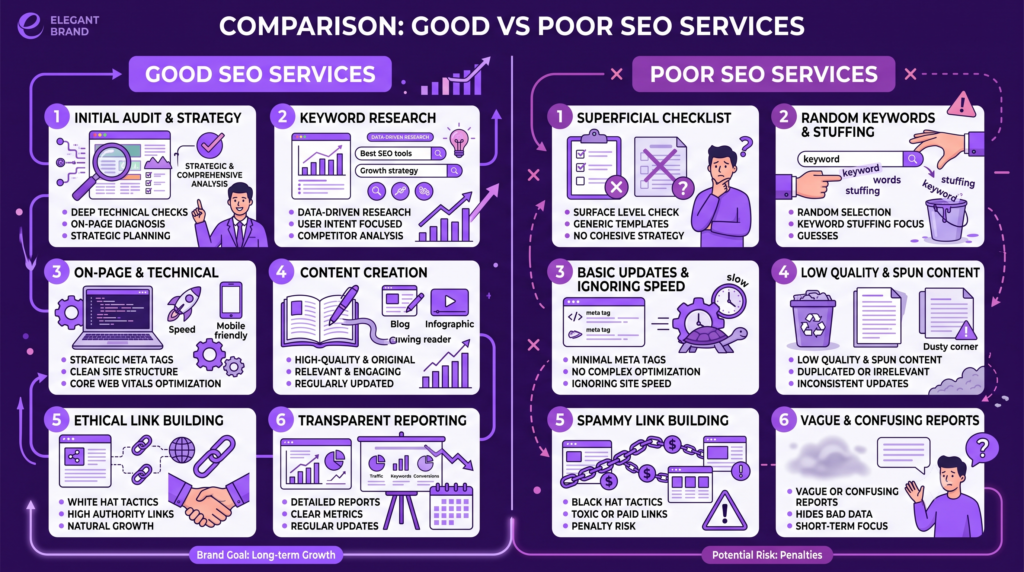
Comparison showing what good SEO services include versus poor SEO services
Frequently Asked Questions
What is SEO?
SEO (Search Engine Optimization) is the practice of optimizing your website and content so it ranks higher in search engine results pages. It involves improving your site’s technical foundation, content relevance and external authority signals so search engines confidently recommend your pages to users searching for related topics.
How long does SEO take to show results?
Most websites begin seeing measurable seo services improvements within 3 to 6 months. Significant organic traffic growth is typically visible between 6 and 12 months. The exact timeline depends on domain age, competition level, content depth and the quality of the technical foundation in place.
What are the three types of SEO?
The three core types are technical seo services (site infrastructure, crawlability, speed), on page seo services (content, keywords, headings, meta data) and off page seo services (backlinks, brand mentions, authority signals). All three must work together for effective rankings.
How much do SEO services cost?
Affordable seo services vary widely in price depending on scope, competition and deliverables. Monthly retainers typically range from $300 for focused small business SEO to $1,500 or more for comprehensive authority campaigns covering technical, content, and link building across highly competitive markets.
Is SEO still relevant in 2026?
More than ever. With AI search expanding across Google, ChatGPT, and Perplexity, strong organic seo services are now the foundation for both traditional rankings and AI citation visibility. Businesses that invest in SEO are better positioned for the AI-first search landscape than those relying solely on paid advertising.
What is the difference between SEO and PPC?
SEO builds organic visibility that compounds over time without paying for each click. PPC (pay-per-click) generates immediate traffic but stops the moment you stop paying. The most effective digital marketing strategy uses both: PPC for immediate lead generation while SEO builds the long-term organic foundation.
Final Thoughts
SEO in 2026 is not what it was five years ago. The technical requirements are higher. The content quality bar is higher. And the emergence of AI search has added an entirely new dimension that most businesses are not yet optimizing for.
But the fundamentals have not changed. Search engines want to recommend the most relevant, trustworthy, and useful content for every query. If your website genuinely delivers that with a solid technical foundation, well-structured content and earned authority – you will rank.
What has changed is how broad “ranking” now needs to be. Being on page one of Google is no longer the only goal. Being cited in AI-generated answers, appearing in Google AI Overviews and building a brand strong enough that AI systems recognize and recommend you by name. These are the goals that define successful seo marketing in 2026.
If you want to explore what that looks like in practice for your specific business and market, I offer a free SEO audit that covers both your traditional search performance and your AI citation readiness.